
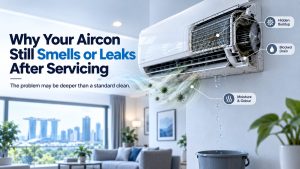
You just paid for a service. The technician came, cleaned the filters, wiped down the unit, and left. Three days later, the musty smell is back or worse, water is dripping from the indoor unit onto your floor. If this sounds familiar, you’re not imagining it, and you didn’t waste your money on a bad technician. You paid for the wrong type of service for the problem you actually have. Almost nobody explains this clearly before you book, so here’s the technical truth.
A standard service and a deep clean are not the same job
Most homeowners assume “aircon servicing” is one uniform task, the technician opens the unit, cleans what’s dirty, and closes it back up. In reality, a standard general service is designed to catch the early stage of dirt buildup: a light wash of the filter, a quick wipe of the visible coil surface, and a check that the system is running. It is preventive maintenance, done on a healthy unit, to keep it healthy.
It was never designed to fix a unit that has already crossed into contamination. And that distinction is exactly where most “still smells after servicing” complaints come from.
Why the smell comes back
The evaporator coil inside your indoor unit is cold and constantly damp while it runs; that’s simply how cooling works. In Singapore’s humidity, this damp surface is close to ideal for microbial growth. Dust and skin particles that pass the filter settle on the wet coil, and within days a thin biological layer, commonly called biofilm, starts to form across the coil fins and the blower wheel behind them.
A standard servicing wipes the outer surface and cleans the filter, but a filter only catches loose dust in the air, it does nothing for buildup that’s already stuck to the coil or wrapped around the blower fan. The blower wheel in particular sits deep inside the unit, behind the coil, and isn’t reachable during a quick service. So the smell doesn’t return because the servicing was done badly. It returns because the source was never physically removed, it was just cleaned around.
The only way to actually remove established biofilm and mould is a chemical wash: the technician dismantles the unit further, removes the blower wheel, and soaks the coil and fan in a cleaning solution strong enough to break down the buildup, before rinsing everything and reassembling the unit. This is a longer, more invasive job than routine servicing, which is exactly why it isn’t part of a standard visit and typically costs more.
Why leaking after servicing isn’t always the technician’s fault
Water leaking from an indoor unit usually traces back to one of three separate causes, and they require completely different fixes:
A blocked or slow-draining condensate line. Condensation from the coil is supposed to flow out continuously through the drain pipe. Biofilm, dust, and even insect nests can build up inside that pipe over months, narrowing the passage until water backs up and overflows the drain pan sometimes suddenly, if the very last bit of blockage gives way after a service disturbs it.
A refrigerant issue causing the coil to ice over. If refrigerant is low from a slow leak, the coil can get too cold and frost or ice forms on it during operation. When the unit is switched off, or during the next cooling cycle, that ice melts faster than the drain can handle, and it looks exactly like a normal leak even though the root cause is refrigerant pressure, not drainage.
An installation fault that’s been there since day one. If the indoor unit wasn’t mounted with the correct slight tilt toward the drain outlet, or the drain pipe run has a dip that traps water, condensate can sit and overflow regardless of how clean the unit is. No amount of servicing fixes a structural installation problem, it needs to be corrected at the mounting point.
This is why a technician who genuinely diagnoses the cause rather than defaulting to “we’ll just service it again” is worth more than one who repeats the same standard visit each time. If the same leak or smell returns within days of a service, the honest answer is usually that the visit addressed the surface, not the source.
What this means before your next booking
Before your next appointment, it’s worth telling the technician exactly what’s happening, musty smell on startup that fades, water pooling near the indoor unit, or a smell that only appeared after haze or heavy rain rather than just booking “a service.” That detail changes whether you need a standard clean, a chemical wash, or a drain and refrigerant check. A company that asks these questions before quoting is generally more trustworthy than one that quotes a flat price without knowing what’s actually wrong.
Aircon servicing done properly is diagnostic first, cleaning second. Skipping the diagnosis is how the same complaint keeps coming back every few months, at your cost each time.
If your unit still smells musty or is leaking after a recent service, it’s worth having it properly assessed rather than booking the same visit again. Our team diagnoses the actual cause before recommending a fix to see how our aircon servicing in Singapore approach works.